Find an E2 Visa Attorney
For business owners and investors globally, the United States stands as an unparalleled platform for ideas and opportunities. The E2 investor visa serves as a powerful gateway for individuals from treaty countries to join this vibrant ecosystem, not as an observer, but as a key player in the American economy. This visa enables you to purchase or start a business on U.S. soil and to stay in the United States to manage and grow that enterprise. It is a flexible and accessible option for those who don't necessarily need prior entrepreneurial experience but possess the resources and drive to succeed. This guide will explain the path to securing an american e2 visa, describing the requirements, investment criteria, and key factors that can turn your vision of running a U.S. business into fruition.
Core Concepts
- The american e2 visa is a non-immigrant visa for entrepreneurs from nations that have a commercial treaty with America.
- You need a significant investment in a genuine U.S. business, with no specified minimum amount, but generally more than $100,000.
- The E2 visa is a treaty investor visa, meaning citizenship in a qualifying country is a basic requirement for eligibility.
- These E2 visa investment requirements are flexible, highlighting the proportionality of the investment to the business and the necessary risk element of the investment.
- The application for an E2 investor visa USA calls for a thoroughly developed business proposal and detailed funds verification documentation.
- Working with a knowledgeable E2 visa attorney is key for successfully navigating the comprehensive application process and optimizing your chances of approval.
The E2 Visa Gateway: Your Path to American Business
Acquiring an american e2 visa resembles a golden ticket-a chance to bring your entrepreneurial skills and funds to the United States. Yet, this invitation requires a specific set of criteria that have to be fulfilled. The core eligibility qualifications are established to ensure that the candidate is a genuine investor with a genuine business purpose. Most importantly, the applicant must be a citizen of a country that holds a treaty of commerce and navigation with the United States. Second, the investor must have allocated, or be actively investing, a "substantial" amount of funds in a bona fide U.S. enterprise. Finally, the investor must possess at least 50% ownership of the business or hold operational control through a managerial role. The candidate must also prove an willingness to leave the U.S. upon the expiration of their E2 status, as it is a non-immigrant visa.
The Treaty Investor Visa: A Bridge Between Nations
The E2 visa is primarily a treaty investor visa. This means its availability depends on mutual agreements between the United States and other nations. These international trade agreements are established to promote business and trade relationships, and the E2 visa directly results from that international cooperation. It serves as a bridge, permitting investors from treaty nations to participate in the U.S. economy while advancing their own business goals. The list of treaty countries is specific, and it represents the crucial first step for any candidate. Without being a citizen of an eligible country, an individual is not permitted to apply directly for this visa category. It is vital to confirm your country's presence on the current E2 treaty list before beginning the application process.
Navigating E2 Visa Investment Requirements: Essential Knowledge
A key advantage of the E2 visa is how adaptable its investment requirements are. Different from other investor visas that specify a fixed, high-value dollar amount, the E2 visa follows the concept of a "substantial investment." This represents a thoughtfully flexible approach, as the E2 visa investment requirements are not defined by a specific number but rather determined by the nature of the business itself. The investment needs to be adequate to guarantee the proper management of the enterprise, proving the investor's serious intent and the business's feasibility. This proportionality is crucial; a small business might demand a lower investment to be considered substantial, while a larger, more complex venture would necessitate a higher capital investment.
Beyond the Dollar Figure: What Defines an Investment?
A considerable investment is funding that is enough to launch and maintain the business. While a figure of $100,000 is generally regarded as a standard benchmark, the U.S. authorities have approved applications with less. The crucial factor is that the investment must be commensurate with the total cost of the enterprise. For example, a $75,000 investment might be considered substantial for a small consulting firm but would be not enough for a manufacturing plant. The investment can comprise more than just cash; it can include non-cash assets such as equipment, inventory, and intellectual property. The funds must be irrevocably committed to the business, meaning they are "at risk" of being lost if the venture fails. This "at-risk" requirement is essential and means that the investment must not be backed by the assets of the business itself, nor can there be any assured returns.
The E2 Business Lifecycle: Starting Up to Selling Out
The E2 visa provides an impressive level of freedom in the type of business an investor can pursue. You aren't limited regarding industry choice or business structure, allowing entrepreneurs to leverage their existing skills and passions. The key alternatives comprise starting a new business from the ground up, buying an established American business, or buying into a qualifying franchise. Each approach presents unique opportunities and obstacles. Launching a new venture provides full creative freedom but comes with the greatest risk and requires a detailed business roadmap. Buying an existing business provides an existing clientele and income flow but necessitates comprehensive evaluation to assess its financial status and operational effectiveness. Franchising can provide a tested business framework, brand recognition, and regular guidance, which can be a safer alternative for new business owners or those pursuing a more structured approach. Whatever route is chosen, the business must be a bona fide enterprise, actively engaged in commercial activities, and not merely a subsistence business for the investor's benefit.
The Strategic Approach: Building Your E2 Investor Visa USA Application
A successful E2 investor visa USA petition demands careful preparation and comprehensive documentation. The process involves more than just filling out forms; it calls for the creation of a thorough package that clearly presents the business venture and investor profile. The foundation of the application is the detailed business plan, which must detail the business objectives, market analysis, financial projections, and a five-year staffing plan. This plan must prove the enterprise's feasibility and its capacity to generate more than just a marginal income for the investor. The documentation must also include thorough documentation establishing the legitimate origin of investment capital, the investor's control and administration of the enterprise, and the substantial nature of the investment. Every piece of documentation must be coherent, accurate, and effectively show compliance with all E2 regulations. This thorough documentation is crucial for a efficient adjudication process.
Living in America: Understanding E2 Visa Benefits and Reality
Residing on an E2 visa offers a distinctive blend of prospects and duties. A key advantage is the possibility to renew the visa indefinitely, as long as the business stays operational and fulfill the program's requirements. This enables prolonged living in the United States, offering stability for the business owner and family members. The E2 visa further extends significant benefits for the investor's family. E2 investor visa USA The marital partner of an E2 visa holder can obtain work authorization, permitting them to seek employment anywhere in the U.S. Dependent children under 21 can come with the investor and enroll in U.S. schools, benefiting from the American education system. However, it is important to note that the E2 is a non-permanent visa, and holders must maintain an intent to depart the U.S. upon the end of their E2 status. This non-immigrant intent is a crucial difference from immigrant visas and must be authentic and provable.
Beyond Basic Citizenship: The Grenada CBI Advantage
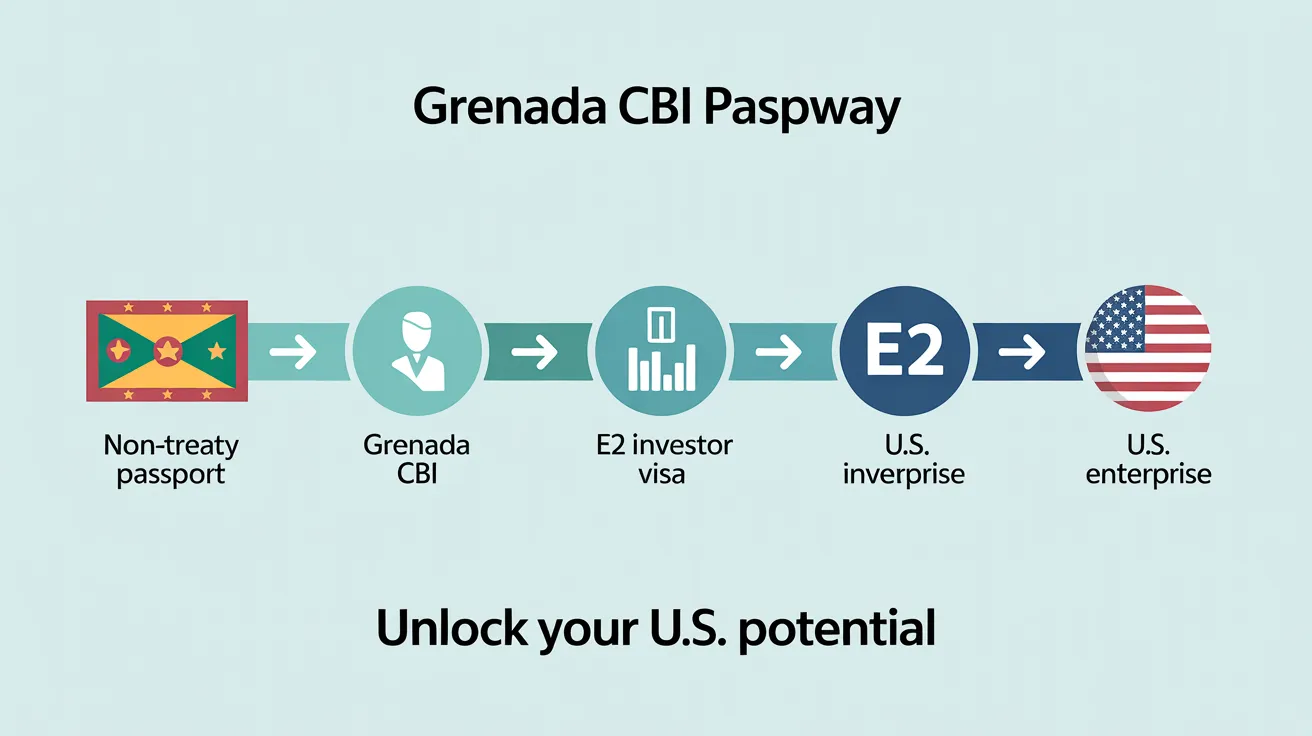
What if your country of citizenship is not listed on the E2 treaty list? For many business-minded individuals, this can seem like an insurmountable roadblock, a closed door to their American investment goals. However, there is an effective and widely used solution: obtaining citizenship in a treaty country through a Citizenship by Investment (CBI) program. Grenada, an idyllic Caribbean nation, maintains a valid E2 treaty with the U.S. and features a respected CBI program. By undertaking a qualifying investment in Grenada, an investor can acquire Grenadian citizenship and, in turn, become eligible to pursue an E2 visa. This two-step process has created opportunities to the U.S. for countless investors from non-treaty nations, delivering a legitimate and effective pathway to E2 eligibility. It's a strategic maneuver that converts a challenging situation into a tangible opportunity.
Your Legal Ally: The Vital Role of an E2 Visa Attorney
Navigating the E2 visa process is intricate, with various legal aspects, evolving regulations, and detailed documentation demands. Managing this complex process without specialized assistance poses substantial risks that can result in time-consuming delays or refusal. An experienced E2 visa attorney functions beyond legal guidance; they are a crucial ally in your path to immigration. They will assist you in conducting thorough due diligence on prospective ventures, meticulously structure your investment to fulfill the "substantial" and "at-risk" standards, create a strong business plan, and carefully track your funding sources. Moreover, they will help you navigate the application and interview process, anticipating potential issues and resolving them early. The value of an E2 visa attorney lies in their ability to present your case in the most advantageous way, maintaining adherence with all regulations and maximizing your probability of acceptance. Their experience can be the key difference between a successful application and a burdensome, prolonged refusal.
The E2 Visa as a Stepping Stone: Charting Your Long-Term Future in the U.S.
Although the E2 visa is primarily a non-immigrant visa, it can serve as a valuable stepping stone for those who wish to pursue permanent residency in the United States. While the E2 visa itself does not offer a direct path to a copyright, the presence and experience in the U.S. it provides can unlock other pathways. For example, an E2 investor may ultimately be able to qualify for an EB-5 immigrant investor visa if their business expands substantially, they can make a qualifying investment, and create the required number of jobs. Alternatively, they may be qualified for an employment-based copyright, such as the EB-1C for multinational managers or executives, if their business grows to a certain scale. The E2 visa provides a flexible platform from which to build a successful U.S. business and, consequently, plan a long-term future that may include permanent residency.
Common Questions
How long does an E2 visa allow me to remain in the United States?
The E2 classification is a non-immigrant visa which, that doesn't offer permanent residency. However, it can be renewed indefinitely as long as the underlying business remains active, stays financially sound, and satisfies all visa conditions. The starting visa validity period usually extends from three months to five years, according to your country of citizenship and the reciprocity schedule with the U.S. Department of State. Although the visa stamp in your copyright may expire, you can remain in the U.S. in E2 status as long as your business continues to be successful and you maintain your non-immigrant intent. Each time you depart and re-enter the U.S., you will usually be granted a two-year period of admission. It is important to note that you must preserve an intent to leave the U.S. if your E2 status ends, as this is a fundamental requirement of the non-immigrant visa category.
Is there a cap on the number of E2 visas issued each year?
Actually no, one of the key benefits of the E2 visa program is that there aren't any annual restrictions on how many E2 visas can be granted. This differs from many other U.S. visa categories, like the H-1B, which are subject to strict annual limits and often require a lottery system. This means that when you satisfy all the qualifying criteria for the E2 visa, you can apply at any time without needing to consider a limited number of visa openings or a lottery. This makes the E2 visa a more predictable and accessible option for eligible investors from treaty countries.
Can I use a loan to finance my E2 investment?
It is indeed possible to utilize a loan to finance a portion of your E2 investment, but certain criteria must be followed. The loan must be secured by your personal assets, and you need to be personally liable for the debt. This signifies that the loan must not be secured by the company's own assets, nor can it be an unsecured loan. The part of the investment that is financed by an unsecured loan cannot be counted as part of your "at-risk" capital, which is a crucial requirement for the E2 visa. As a result, while loans can be part of your investment strategy, they have to be structured carefully to comply with USCIS regulations, and it is extremely important to consult with an experienced E2 visa attorney to maintain compliance.
Do E2 visa dependents have permission to work and study in the United States?
One of the key benefits of the E2 visa is the complete package of benefits available to your immediate family. Your spouse is eligible to apply for an Employment Authorization Document (EAD) when arriving in the U.S., which allows them to work for any employer in the U.S. without restriction. This provides valuable flexibility and can considerably improve the family's financial well-being. Your unmarried children under 21 may also come with you on E2 dependent visas and can attend U.S. public or private schools, benefiting from the American education system. Nevertheless, once children turn 21, they no longer qualify for E2 dependent status and need to seek their own independent visa options to remain in the U.S.
Can an E2 visa be converted to a copyright?
The E2 visa does not provide a direct path to a copyright, as it is classified as a non-immigrant visa category. You must maintain a genuine intent to return to your country of origin upon the termination of your E2 status. Nevertheless, the E2 visa can act as a strategic platform for seeking other immigration routes that provide permanent residency. For example, by establishing and growing a successful business in the U.S. under an E2 visa, an investor may eventually become eligible for an EB-5 immigrant investor visa if they fulfill the substantial investment and job creation requirements. Additionally, if the business develops to a certain size and structure, the investor may become eligible for an employment-based copyright, including the EB-1C for multinational managers or executives. Consequently, while not a direct route, the E2 visa can be a useful stepping stone towards long-term permanent residency in the United States.